Published on: 11 June 2026
Artificial intelligence (AI) is reshaping the cyber security landscape at a rapid pace. AI technologies are no longer limited to content generation, chat assistance and document summarisation. They are increasingly capable of analysing complex information, using tools, interacting with information systems and supporting multi-step workflows, and both defenders and threat actors are taking notice.
This development creates new opportunities for organisations to enhance productivity, improve security operations and strengthen cyber resilience. In cyber defence, AI can help process large volumes of security data, identify abnormal behaviour, prioritise alerts and support faster investigation. When adopted in a controlled and well-governed manner, AI can become a valuable capability for defenders.
At the same time, the shift from information support to operational capability changes the nature of cyber risk. The same capabilities that help organisations work faster and more effectively may also be abused by threat actors to accelerate cyber attacks. As frontier AI models become more accessible, malicious operations will become faster, boarder in scope and less dependent on specialist technical skills.
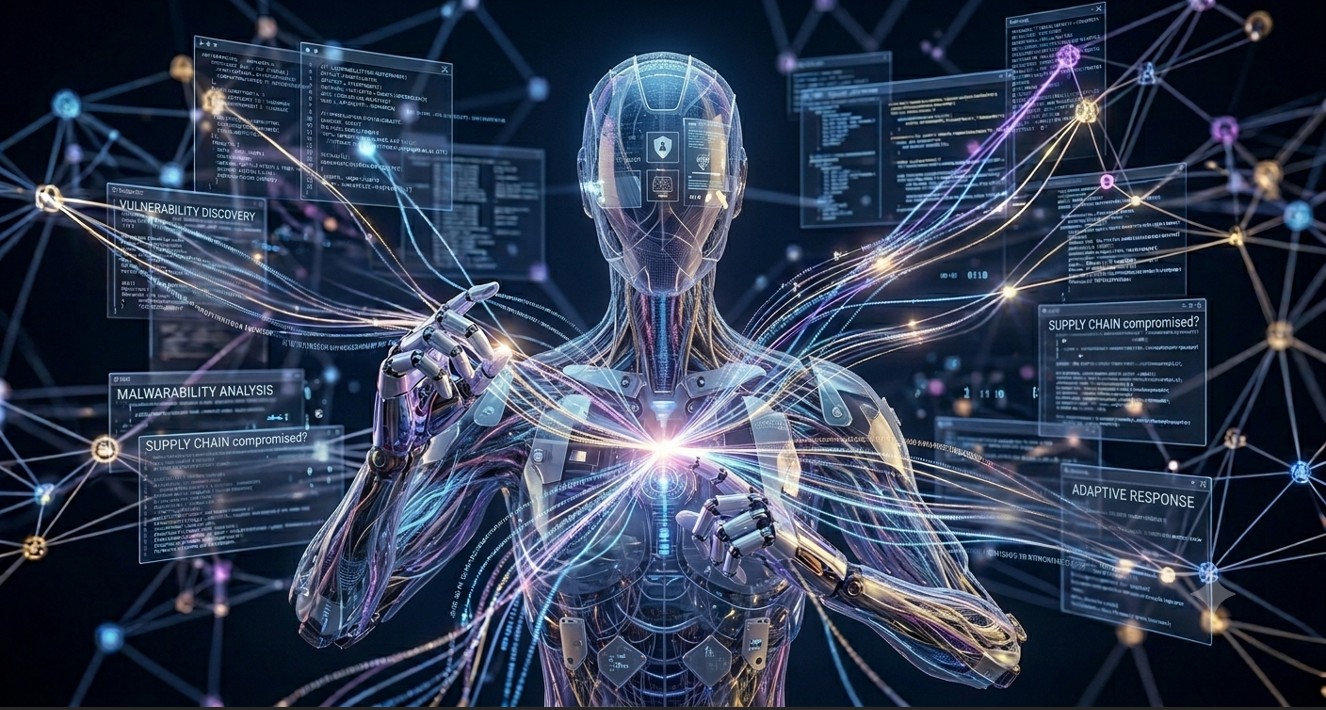
For organisations, the key concern is not only whether AI introduces new types of threats. The more immediate issue is how AI amplifies existing cyber risks. Reconnaissance, vulnerability discovery, phishing, malware development, supply chain compromise and incident response may all be accelerated by the growing operational capability of AI.
AI is Changing the Economics of Cyber Operations
AI can act as a profound force multiplier. For defenders, it improves the speed and reach of security monitoring, analysis and response. For attackers, it drastically reduces the time and effort required to collect information, analyse targets, identify weaknesses and orchestrate attack materials. Activities that previously required substantial manual effort may now be repeated at a fraction of the cost and at a vastly greater scale.This creates a more dynamic risk environment.
Accelerated Exploitation: Vulnerabilities can be discovered and weaponised before traditional patching cycles can react.
Hyper-Personalised Phishing: Phishing messages are becoming fluent, personalised, and context-aware, making them nearly indistinguishable from legitimate business communications.
Polymorphic Evasion: Malicious scripts and payloads can be modified automatically and frequently to evade static detection rules.
Precision Supply Chain Risks: Attackers can leverage AI to map vast software dependencies, identify obscure open-source vulnerabilities, and craft highly convincing deceptive packages.
The concern is not only the sophistication of individual attacks, but the speed at which different attack steps can be chained together. The attack lifecycle may become more compressed, with attackers moving more quickly from reconnaissance to exploitation, and from exploitation to wider compromise. Organisations may therefore have less time to detect suspicious activity, remediate weaknesses and contain incidents.
AI will not replace human intent, judgement or expertise in cyber operations. However, it can increase the productivity of capable actors and lower the barrier for less-skilled ones. Organisations should expect cyber attacks to become more scalable, adaptive and harder to distinguish from legitimate activity. Weak asset visibility, excessive privileges, insecure configurations and delayed patching may therefore carry greater consequences in the AI era.
Strengthening the Cyber Security Foundation
There is no single silver bullet for AI-enabled cyber threats. As cyber operations become faster, more automated, and more scalable, organisations should continue to strengthen their cyber security foundations and ensure that existing controls remain resilient in the evolving threat landscape.Radical Asset Visibility: A strong foundation begins with knowing your terrain. Organisations must maintain accurate, real-time inventories of hardware, software, cloud services, shadow AI tools, APIs, and system integrations. Visibility enables organisations to accurately assess their exposure and prioritise remediation.
Rigorous Least Privilege: Access rights must be tightly managed and regularly audited. Human users, service accounts, APIs, and automated AI workflows should be granted only the absolute minimum access necessary for their functions. This prevents a localised compromise from escalating into a catastrophic breach.
Attack Surface Reduction: Organisations should continuously review system configurations and eliminate unnecessary exposure, including forgotten testing interfaces, unencrypted cloud storage, and legacy Internet-facing assets. Minimising the attack surface reduces the low-hanging fruit that AI engines can scan and exploit instantly.
Risk-Based Patching: Timely remediation of discovered vulnerabilities remains non-negotiable. To address increasingly compressed exploitation windows, organisations must adopt a structured, risk-based patching approach, prioritising vulnerabilities affecting internet-facing systems and authentication infrastructure.
Holistic, Context-Aware Monitoring: Comprehensive visibility must span information systems, networks, applications, cloud platforms, and internal AI deployments. Relevant logs, including account access, API tokens, configuration drift and automated workflows, must be aggregated and monitored to support early detection and rapid forensics.
Using AI to Strengthen Defence
AI is not purely an adversarial challenge. When introduced thoughtfully, AI-enabled defence can meaningfully shift the balance, giving security teams greater reach, faster insight and the ability to act before threats escalate.Security teams have long faced an asymmetric burden: attackers need to find only one weakness, while defenders must protect everything, all the time. AI begins to address this imbalance. By processing large volumes of security data at speed, AI can surface threats that would otherwise go unnoticed and free analysts to focus on work that requires human judgment.
Furthermore, the opportunity extends beyond detection. AI can support proactive defence by surfacing control gaps and configuration weaknesses before attackers discover them. Where appropriate, it may also recommend or initiate containment actions such as disabling suspicious accounts or isolating affected information systems, compressing the time between detection and response.
Building a Structural Advantage
The AI era requires organisations to build structural advantages by strengthening the capabilities, agile processes and governance frameworks that enable defenders to move faster, make better decisions and reduce the impact of attacks.Organisations should not wait for AI-enabled threats to fully mature before taking action. AI is already changing the speed, scale and accessibility of cyber operations. By improving asset visibility, strengthening access controls, governing AI adoption and preparing response arrangements for AI-related security incidents, organisations can maintain a meaningful advantage over threat actors in the AI era.
The core fundamentals of cyber security remain unchanged. Securing the AI frontier simply means executing those fundamentals flawlessly, continuously, and faster than ever before.
Related topic(s) :